
Sure Sugar
Shouldn’t these two English words be spelled with SH?

Despite its reputation and the infamous evidence to the contrary, I’m committed to demonstrating how regular English spelling actually is. Yet words like sugar and sure, I admit, mock that vocation.
In being pronounced as if they began with SH, the pair require me to reach begrudgingly for a particular word to describe their spelling. That word is irregular. What I mean by this reluctantly applied label is that I can’t formulate the relationship between their initial sound and symbol as a rule. ‘S is pronounced like SH before U’ would be the rule, if it didn’t of course fail in most instances, such as subject, sublime, sunrise, superb, supply, surname and such – unless you happen to speak like/be Sean Connery.
Just because an element of spelling is irregular, though, doesn’t mean it’s inexplicable. We can indeed explain these orthographically awkward words. That’s exactly what this article will attempt to do.
To be clear, the combination of S and U is far from being an otherwise reliable duo in English words. Consider the S in words like measure and visual, pronounced with a ZH-sound that deserves its own article. Very appropriately, I also wrote that article.
In those other cases, the duplicitous S spells part of an unstressed syllable, one that doesn’t bear the primary stress that spoken English adds to all non-monosyllabic words. When there’s no stress to protect them, sounds can get mushed and mashed in all sorts of ways, as our mouths hurry past them en route to more important syllables.
But what’s happened with measure and visual doesn’t apply to sugar and sure. Here the S is preceded by nothing, and in sugar it’s part of the stressed syllable. The sound-sign mix-up holds in the words’ derivatives; sure is the head of a word family that includes assure, insure and unsure. In each of these, sure is the root, and as such it provides the stressed syllable. Thus considered, sugar and sure suddenly seem rather exceptional.
Word stress (and lack thereof) is not at fault here. So, we have to blame this oddity on something else – or rather, on someone else, namely the Normans, in collaboration with the Tudors.
Once upon a time, there was a big battle and one side lost very badly. After 1066 and all the kerfuffle in Hastings, the conquering Normans settled down to rule England and drown the local Germanic language in the largely Latinate vocabulary of France.
These invasive words contained a lot of the sound /y/. This vowel, written with the letter U among the Normans, is made with lips rounded and tongue thrust up and forwards in the mouth. It’s common in French (e.g. sucre, sûr, tu) and German (e.g. Bücher, grün, über), but English then and now won’t hear of it. Instead, speakers of Middle English took the words and approximated the vowel therein.
Their best shot at the sound was /iu/, sounding like eww. Pronouncing Latinate U-words with /iu/ can still be heard in Welsh English, but in the English of elsewhere, it became /ju/ (IPA notation) – that is, ‘yoo’. This was a sequence of consonant and vowel that remains present in the pronunciation of cute, fuse, music, puny and use, and indeed is the name of the letter U itself.
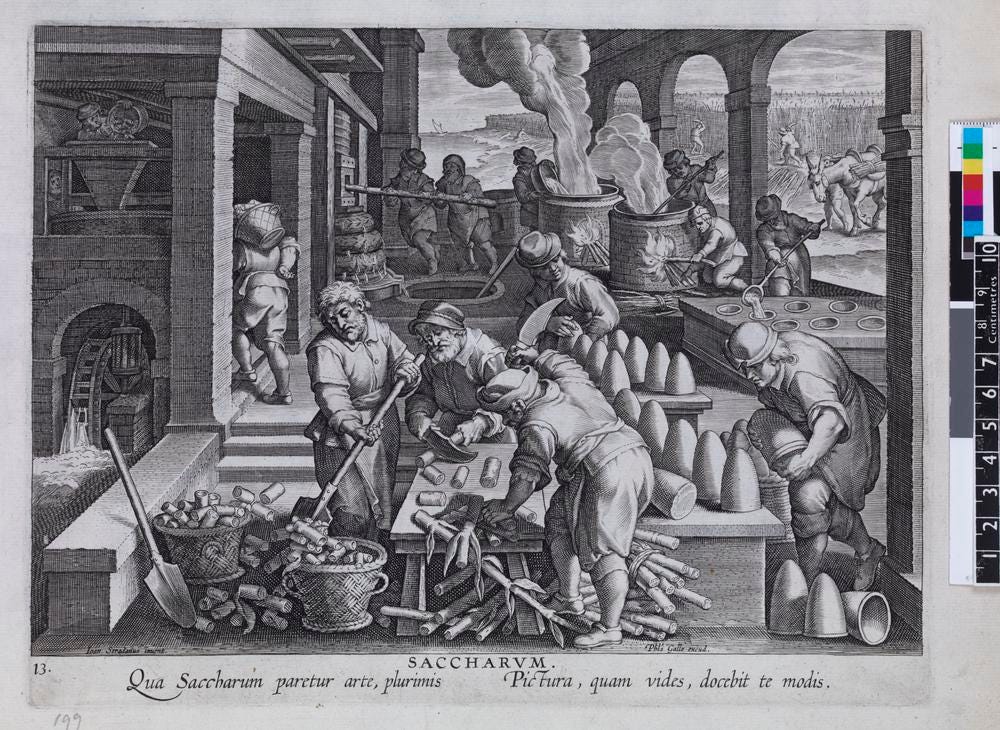
Among the post-1066 acquisitions that Middle English speakers would’ve said with /ju/ were sugar and sure. Both first documented in English around the year 1300, sugar and sure were for Chaucer pronounced like ‘syoogar’ and ‘syoor’.
How can we know this? Well, for one reason, that’s how they’re spelled. Our letters should always be our first calling point on the journey into the linguistic past. In the case of our two words, they’ve been written down with an S since their first documented appearances in the 13th and 14th centuries – sure always so, although sugar varies between C, S and Z in the earliest examples. The variability is due to sugar’s distinct history as a substance and as a word, having travelled to medieval Europe from Arabic, though ultimately from the languages of India.
That brings us to another reason: etymology. The two words start with a sibilant /s/ sound in their land of immediate origin to this day; in French, they’re sucre and sûr. The latter goes back to Latin sēcūrus (‘carefree, safe’, literally ‘without-care’); this is also the origin of secure, and it started with an S-like consonant too. There’s no reason why, at least to begin with, the English acquirers would not have kept up the same sibilant sound as could be heard across the Channel.
For another reason, we have plenty of poetic alliteration. Middle English verse was often constructed to make word-starting sounds and letters match:
May no sugre ne swete thyng
Aswage my swellyng?
…
And diden me suren hym sikerly
To serven hym for evere
(William Langland’s Piers Plowman, c. 1380)
Also, as a general rule, we can presume that all incoming U-words were at one point or another pronounced with /ju/, simply because this is the way Middle English speakers approximated that single sound of their socio-cultural superiors. It did not remain that way in all relevant words, however.
Down the generations, speech tends to progress from neat to messy, as sounds interact with their neighbours in the words we’ve put them into. The U sounds like ‘yoo’ in cute, fuse, music, puny and use, but not in ruby and rude, and diminishingly so in evolution, illuminate and lunar. A dying breed of speakers would pronounce that last Latin loanword as ‘lyoonar’. Whichever consonant precedes the U may have meant that the ‘yoo’ component became just ‘oo’.
A related and relevant point is that many of the acquisitions with SU ended up with a short U-vowel in Middle English. Either they arrived with it or had it shortened through overuse and a lack of word stress. This set of U-words then followed their own path as Middle English became Modern. Words like suburb, sudden, support and survive are all Norman/French/Latin in origin, but their shared U, having been made briefer in duration, has gone down a sound different path than the longer one in super. We can put their group of words to one side, to concentrate instead on the super-subset that includes assume, suit, superior, supreme and pursue – and also this article’s two subjects.
By the 15th century, whatever members of this set were already in circulation, sugar and sure were among them – and they were pronounced ‘syoogar’ and ‘syoor’. However, in the following century, phonetic fusion would see them subtly change.
Just as the rise of the ZH-sound in measure can be dated to this period of Early Modern English, Tudor tongues had a taste for merging sequences of /sj/ into one sound. As a combination of the features of the two consonants, the outcome was the palatal sound still to be heard at the start of sugar and sure: /ʃ/. They thus went from ‘syoogar’ and ‘syoor’ to ‘shoogar’ and ‘shoor’.
This was a common and reasonable sound change (‘yod-coalescence‘ if you like a technical term), which gradually took hold in 15th- and 16th-century English. It probably began in unstressed syllables, before laying siege to stressed ones in the 1500s. Just as it’s responsible for the TI in information that sounds like SH, this change gets us from our two star words’ Middle English pronunciation to how they are uttered today – at least if you’re me.
(Here I must acknowledge my accentual bias and note a further merger, which has been making sure homophonous with shore. My personal accent doesn’t have this merger, but most people around me now do; it’s a little uncomfortable to experience becoming conservative and archaic before one’s very ears.)
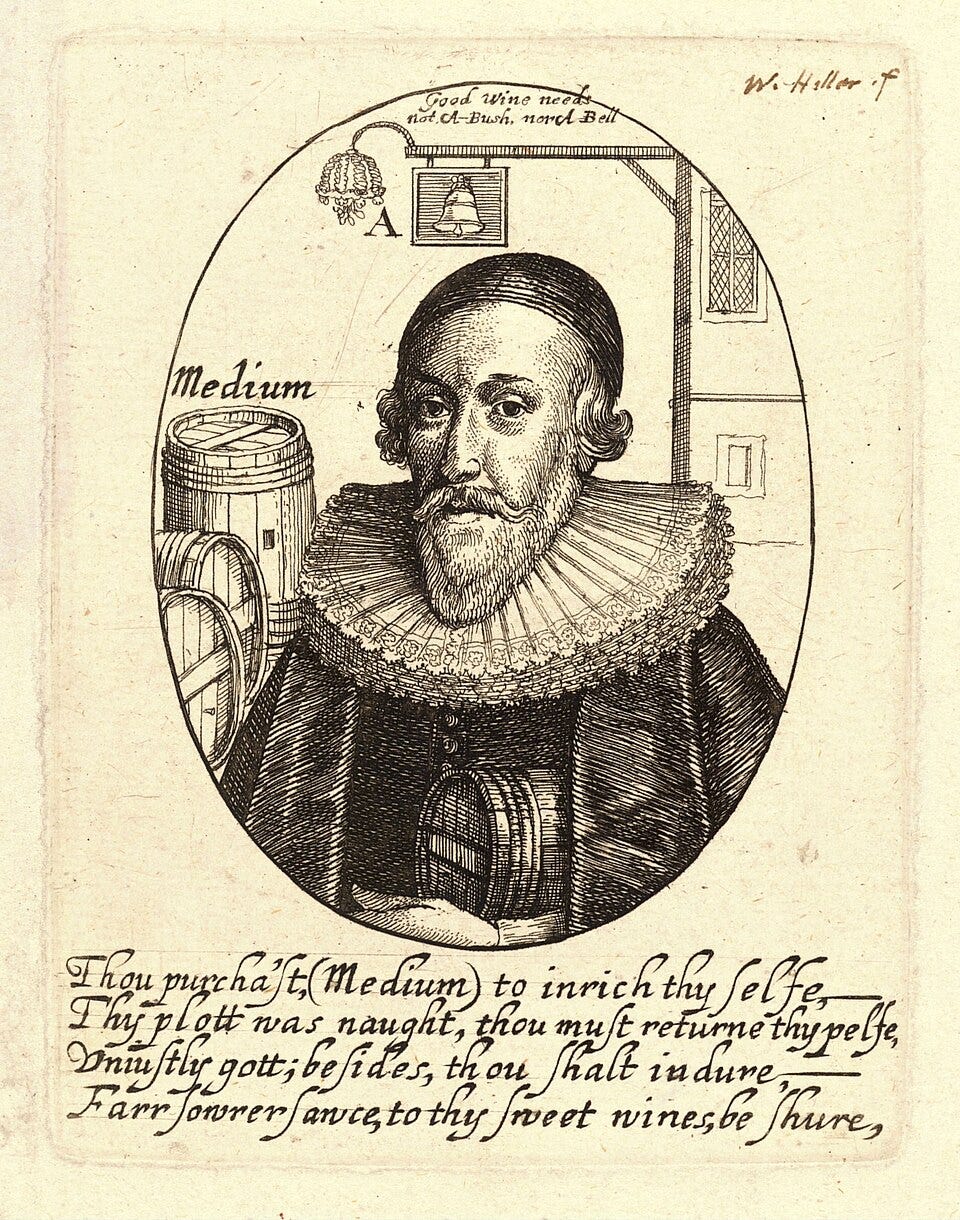
Sugar and sure shifted in shound, but their written forms lagged behind. It was one thing to let speech progress away from the past; it would be another matter entirely to allow the visual form to follow it into the future. Other than occasional variant spellings like “shugar” and “sheure” from the 1600s, English writers have been content not to update the S to SH. English learners have had to put up with it.
I am shure you know him, tis Doctor Cayus.
(William Shakespeare, The Merry Wives of Windsor, c. 1602)
A shift from /sju/ to /ʃu/, in combination with unchanged spelling, gives us what we need to understand the S of sugar, sure and their lexical offspring. What it doesn’t give us is an explanation for the unaffected others in the set – why super and suit aren’t said ‘shooper’ and ‘shoot’.
Actually, they might well have been, had English speakers then not backtracked on the change. This is the thing I find most fascinating; it seems that Early Modern English, or at least segments within its speakerdom, got cold feet about going down this road. The total shift from /sju/ to /ʃu/ was felt by some to be a step too far. Ultimately believing it better to preserve /sju/, English speakers progressed no further.
Other relevant words at that time (and later newcomers) have by and large been spared; we do have a few examples from the 1500s and 1600s of suit spelled with SH, but the across-the-board fusion of ‘syoot’ fell through at the last minute. Either it never achieved the numbers necessary for becoming standard, or it was intentionally proscribed from above, and so English speakers did a U-turn on ‘shuit’.
This has left the shift incomplete to this day, remembered only by the two words that fell totally under its spell: sugar and sure.
We can imagine great variation in how the two were pronounced over the course of the 16th and 17th centuries. The possible variants, the old unshifted one vs. the new shifted one, would have coexisted for a while, competing for airtime among different speakers and social contexts. In time, the balance slowly swung towards the innovative pronunciation, as the upstart gained ground and progression from ‘crude’ to ‘normal’ in its connotations, while the senior retreated to the spheres of formality and pedantry. This ebb and flow is present in all eras of language, including our own.
By the 1700s, the status of sugar and sure as standardised oddities of spelling seems secure. Later variants with SH have the sense of being deliberately non-standard, subtle signals of inferiority. We have dictionary writers from that century who include remarks on pronunciation or even their own phonetic systems, and who single the two words out. William Kenrick’s 1773 New Dictionary of the English Language: Containing not only the explanation of words… (title goes on for a while) includes the entries:
“SU’GAR – SU³GA¹¹R, and vulgarly SHU³G-A¹¹R…”
“SURE – SU⁶RE. This word, with its derivatives, is pronounced as if an H preceded the U, thus, SHURE…”
Thomas Sheridan, in his 1780 dictionary, likewise spells them as “ſhu²g’-u¹r” and “ſho³’r”, with an H to indicate the initial peculiarity. The numbers are there to distinguish between vowel sounds – the Georgians too knew the insufficiencies of the English alphabet.
Kenrick’s use of the word “vulgarly” is telling. The SH-like pronunciation is clearly still looked down on by Kenrick and his lexicographical class, being a lowly innovation, an English eccentricity, an affront to etymology, and a departure from spelling. That said, if the lexicographers had embraced the change – both the new sound and a new SH spelling to go with it – speech and writing could’ve kept up with each other. By attempting (and partly succeeding) to turn back the tide of change, linguistic authorities can lead languages into some strange states.
Besides, the intervention was short-lived; saying suit like ‘syoot’ and super like ‘syooper’ nowadays sounds increasingly old-fashioned. This is because English speech has been losing the /j/ from word-initial sequences of /sj/, in favour of simple /s/. Having avoided yod-coalescence, words like super have now fallen to yod-dropping.
But why the two titular words? It’s all well and good to acknowledge their standard status by the 1700s; it doesn’t explain why the shifted versions of sugar and sure specifically were strong enough to avoid the ire and the axe.
I have to speculate here: they made the cut, because the words themselves were common enough in 16th-century language. This seems reasonable to believe; sugar was a foodstuff that a speaker could eat or at least talk about every day in the 1500s, and sure was an everyday adjective. Through common employment (compared with whichever other SU-words were available at the time), the words were free of any controlling linguistic elite that might rein in ‘vulgar’ pronunciation. They could instead establish a broad base of popular usage able to withstand censorious opinions.
I find something hearteningly democratic in that mass resistance to disapproval. The authorities in a community of speakers, be they social superiors or intellectual leaders, carry enormous weight in linguistic matters – but their rule is not absolute. Everyone gets a say in pronunciation, just not an equal one.
The S in sugar and sure is also a testament to our linguistic capabilities, specifically our memory and mental tolerance for irregular spelling. They may be surprising exceptions to the expected combination of S and U, but we learn and wield the two words just fine. It’s not my place to recommend that we update their spelling from S to SH, or even the opposite: to start saying sugar and sure with a /s/. It is my place to say that we could do that, but also that we are generally managing okay with the irregularity.
Finally, the case of sugar and sure is a beneficial reminder for the historical linguist not to lose sight of individual words. To the newcomer, this may seem an odd and unnecessary remark – aren’t words what it’s all about? No, they’re not; the historical linguist not only deals in words but also (and more often) the sounds, letters, grammar and meanings that those words are made up of.
We’re used to language-wide phonological changes that shift all instances of a particular sound; words serve to provide a mass of evidence. But words are the arenas in which sounds old and new fight for victory. In the sugary and sure corners of our lexicon, we find a story of a battle that was started, but not definitively won. Two singular survivors attest to it, and are worth our attention.
‘Surely,’ my dear reader asks. ‘You’re not serious in concluding an article about two English words and their weird spelling with so grand a point?’
I am serious, and don’t call me Shirley.
END.
Resources:
Kenrick’s A New Dictionary of the English Language (1773)
Langland’s Piers Plowman text
Shakespeare’s The Merry Wives of Windsor text
Sheridan’s A General Dictionary of the English Language (1780)
Non-linked references:
Beal, J., Sen, R., Yáñez-Bouza, N., & Wallis, C. (2020) En[dj]uring [ʧ]unes or ma[tj]ure [ʤ]ukes? Yod-coalescence and yod-dropping in the Eighteenth-Century English Phonology database. English Language and Linguistics, 24(3). 493–526.
Bowen, E. (1899). The development of long U in accented syllables in Modern English. Anglia, 22. 465–488.
Dobson, E. J. (1968). English Pronunciation 1500–1700, Vol. II, 2nd edition. Clarendon Press.
Minkova, D. (2013). Historical phonology of English. Edinburgh University Press.
Images my own, from Wikimedia Commons or from credited sources. Only human intelligence (or lack thereof) was used in the creation of this article.
American English still maintains the distinction between "sure" and "shore", so do come over when we've managed regime change. Or go to Canada. Plus most of us kept the R's where they are in spelling, not swapping them!
You may be interested to know that Swedish went through a similar sound change in words that in Old Norse contained the /y/ sound: they went to /ju/ and then affected the preceding consonant: syv (seven) -> sju which today is pronounced similar to Eng shoe; dyr (animal) -> djur (where the d is now silent), ty -> tju (also pronounced similar to shoe but different to sju). By contrast, Norwegian and Danish retain the original -y-. I assume this also helps explain why the sh sound is spelt si- in Welsh...